
Technologies developed at ICAR-National Bureau of Animal Genetic Resources, Karnal (Haryana).
| S.N. | Technology developed | Description of technology | Status |
|---|---|---|---|
| 1. | A Kit for Parentage Verification in Buffaloes (Bubalus bubalis) | This is the first kit of DNA based markers for parentage/paternity testing in buffaloes. The developed kit utilises a single multiplex PCR reaction having 15 genetic markers. The kit has a very high probability of exclusion. The kit has been developed using large buffalo populations from all parts of the country and has performed well in amplification of DNA from vast and varied geographical locations — all markers are polymorphic and exhibit heterozygosity. It performs equally well with swamp buffaloes. | Patent Granted |
| 2. | High Density Chip of Indigenous Zebu Cattle (Bos indicus) | The present invention provides a high density Bos indicus whole genome breeding chip and the application thereof. The high density whole genome breeding chip for indigenous cattle reported in the present invention is a 624745 SNP chip manufactured based on Affymetrix technique. Each chip can detect 96 samples simultaneously and contains 624745 SNP sites. The marker sites have DNA sequences represented by Seq ID No. 1-624745. The chip can be used in molecular marker fingerprint analysis of the indigenous cattle genetic resources, in genotype identification of the crosses of Bos indicus and Bos taurus progenies, for genome wide association studies with traits of interest like milk yield, fat and protein percentage, somatic cell count and unlimited number of variables both natural as well as synthetic and having wide application prospects. The high density whole genome breeding chip has been specially designed and created for the development of a database for generation of prediction equation for selection of sires of high genetic merit in Bos indicus. | Patent filed |
| 3. | High Density Chip of Indigenous Riverine buffaloes (Bubalus bubalis) | The present invention provides a high density Riverine buffaloes (Bubalus bubalis) whole genome breeding chip and the application thereof. The high density whole genome breeding chip for Riverine buffaloes reported in the present invention is a 619203 SNP chip manufactured based on Affymetrix technique. Each chip can detect 96 samples simultaneously and contains 619203 SNP sites. The marker sites have DNA sequences represented by Seq ID No. 1-619203. The chip can be used in molecular marker fingerprint analysis of the development of indigenous Riverine buffaloes resources, in genotype identification of the crosses of Riverine buffaloes and Swamp buffalo progenies, for genome wide association studies with traits of interest like milk yield, fat and protein percentage, somatic cell count and unlimited number of variables both natural as well as synthetic and having wide application prospects. | Patent filed |
| 4. | High Density SNP Chip of indigenous backyard poultry breed | The present invention provides a high density Gallus gallus whole genome breeding chip and the application thereof. The high density whole genome breeding chip for indigenous chicken reported in the present invention is a 622,376 SNP chip manufactured based on Affymetrix technique. Each chip can detect 96 samples simultaneously and contains 622,376 SNP sites. The marker sites have DNA sequences represented by Seq ID No. 1-622,376. The chip can be used in molecular marker fingerprint analysis of the indigenous chicken genetic resources, in genotype identification, for genome wide association studies with traits of interest growth rate, egg production, game utility, protein percentage, disease resistance and unlimited number of variables both natural as well as synthetic and having wide application prospects. | Patent filed |
| 5. | High Density Chip of Capra hircus | The present invention provides a high density Capra hircus whole genome breeding chip and the application thereof. The high density whole genome breeding chip for Capra hircus reported in the present invention is a 626,975 SNP chip manufactured based on Affymetrix technique. Each chip can detect 96 samples simultaneously and contains 626,975 SNP sites. The marker sites have DNA sequences represented by Seq ID No. 1-626,975. The chip can be used in molecular marker fingerprint analysis of the indigenous goat genetic resources, for genome wide association studies with traits of interest like growth rate, carcass parameters, milk yield, fat and protein percentage, somatic cell count and unlimited number of variables both natural as well as synthetic and having wide application prospects. | Patent filed |
| 6. | Medium Density SNP Chip of Bactrian and Dromedarian Camel | The present invention provides a medium density Bactrian and Dromedarian whole genome breeding chip and the application thereof. The medium density whole genome breeding chip for Bactrian and Dromedarian Camel reported in the present invention is a 1,82,122 SNP chip manufactured based on Affymetrix technique. Each chip can detect 96 samples simultaneously. The marker sites have DNA sequences represented by Seq ID No. 1-1,82,122. The chip can be used in molecular marker fingerprint analysis of the camel genetic resources, in genotype identification of the crosses of Bactrian and Dromedarian Camel progenies, for genome wide association studies with traits of interest like milk yield, fat and protein percentage, unlimited number of variables both natural as well as synthetic and wide application prospects. | Patent filed |
| 7. | Linkage Disequilibrium based Low Density SNP Chip of Riverine buffaloes (Bubalus bubalis) | The present invention provides a low density linkage disequilibrium buffalo (Bubalus bubalis) whole genome breeding chip and the application thereof. The number of markers in the present invention is 63739 and the chip is manufactured based on Affymetrix technique. Each chip can detect 96/384 samples simultaneously. The chip can be used in molecular marker fingerprint analysis of the four major breeds of river buffaloes, for genome wide association studies with traits of interest like total milk yield, fat and protein percentage. The low density whole genome breeding chip has been specially designed and created for development of a database for generation of prediction equation for selection of sire of high genetic merit for milk production in Bubalus bubalis. | Patent filed |
| 8. | High Density SNP Chip of Swamp Buffaloes (Bubalus bubalis) | The present invention provides a high density Swamp buffalo (Bubalus bubalis) whole genome breeding chip and the application thereof. The number of markers in the present invention is 621800 and the chip is manufactured based on Affymetrix technique. Each chip can detect 96 samples and contains 621800 SNP sites. The marker sites have DNA sequences represented by Seq ID No. 1-621800. The chip can be used in molecular marker fingerprint analysis of the development of high density Swamp buffaloes genetic resources, in genotype identification of the crosses of Swamp Buffalo and River Buffalo progenies, for genome wide association studies with traits of interest like total milk yield, fat and protein percentage, somatic cell count and unlimited number of variables both natural as well as synthetic and having wide application prospects. | Patent filed |
| 9. | Linkage Disequilibrium based Low Density SNP Chip of Indigenous cattle (Bos indicus) | The present invention provides a low density linkage disequilibrium Bos indicus whole genome breeding chip and the application thereof. The number of markers in the present invention is 63797 and the chip is manufactured based on Affymetrix technique. Each chip can detect 96/384 samples simultaneously. The chip can be used in molecular marker fingerprint analysis of the indigenous milch cattle genetic resources, for genome wide association studies with traits of interest like total milk yield, fat and protein percentage. The low density whole genome breeding chip has been specially designed and created for development of a database for generation of prediction equation for selection of sire of high genetic merit for milk production in Bos indicus. | Patent filed |
| 10. | High density SNP chip for yak (Bos grunniens) — Axiom_Yak | The product is a high density SNP chip of Indian yak (Axiom_Yak) and its application thereof. The Axiom_Yak comprises 627,377 biallelic markers and is manufactured based on Affymetrix technique. The SNPs have been extracted from 30 samples of 3 indigenous yak breeds/populations. Each chip can detect 96 samples simultaneously and contains 627,377 SNP sites which are uniformly distributed across the whole genome. The marker sites have DNA sequences represented by Seq ID No. 1-627,377. The array has been validated on 347 diverse yak samples. Average call rate for QC passing samples was 99%, and 80.404% or 504,435 markers were best and recommended. The poly high-resolution markers accounted for 74.5%. The mono-high resolution markers were found to be only 1.975%. This SNP chip can be utilised for population genetics, association, linkage disequilibrium as well as other genomic studies in yak. | — |
| 11. | High density SNP chip for horses/ponies — Axiom_Ashwa | Axiom_Ashwa is a high-density SNP genotyping array specifically developed for Indian horse breeds. Incorporating 613,950 SNPs, the chip ensures comprehensive genome-wide coverage, with an average inter-marker distance of approximately 4 kb. Designed using Affymetrix technology, the SNPs are designated by sequential identifiers from Seq ID No. 1 to 613,950. These SNPs have been extracted from 53 samples from 6 indigenous horse and pony breeds. The array has been validated by genotyping 96 diverse indigenous horse breeds and Thoroughbreds, with a high genotyping call rate of 99.4%, underscoring its reliability and efficiency for native breeds. Phylogenetic and population structure assessments successfully differentiated horses, ponies and Thoroughbreds. Distinct clustering was evident, separating Marwari and Kathiawari horses from ponies, while Thoroughbreds were distinctly grouped. The chip has strong potential for genome-wide association studies (GWAS), genomic selection, breed differentiation and population genetic studies. | — |
| 12. | High density SNP chip for pig — Axiom_Shukar | The product is a high density SNP chip of Indian pigs (Axiom_Shukar) and its application thereof. The chip consists of 635,974 SNP markers identified from analysis of whole genome re-sequencing data of diverse pig breeds/populations of India, and is manufactured based on Affymetrix technique. The SNPs were extracted from 59 samples from 8 indigenous pig breeds. The marker sites have DNA sequences represented by Seq ID No. 1-635,974. The Axiom_Shukar was validated by genotyping 96 diverse pig samples. All the samples genotyped passed the SNP QC thresholds. The genotyping results identified 553,289 markers as Poly High Resolution (PHR), while only 0.819% were Mono High Resolution (MHR). Only 4.121% of the SNPs exhibited call rates below threshold. Average call rate for QC passing samples was 99.636%, and 91.121% or 579504 markers were best and recommended. The chip has a wide range of applications including genome wide diversity estimation, marker-trait association, selective sweep analysis, genome wide selection, linkage disequilibrium analysis and genomic characterisation of porcine breeds. | — |
| 13. | High density SNP chip for dogs — Axiom_Shwaan | The product is a high density SNP chip of Indian dogs (Axiom_Shwaan) and its application thereof. The SNP array was designed using genomic data from four genetically distinct dog breeds native to India. Incorporating 629,597 biallelic markers, the array was developed using Affymetrix technology. The SNP loci, numbered Seq ID No. 1 to 629,597, are evenly distributed across the canine genome, providing an average inter-marker spacing of 3.8 kb. This dense marker distribution significantly enhances genome-wide coverage and allows genotyping of up to 96 samples on a single chip. Validation was performed using 192 samples spanning 11 indigenous dog breeds and populations. The array achieved a high SNP call rate of 99%, underscoring the reliability of the array and the presence of substantial genetic variability in Indian canine populations. Principal component analysis and phylogenetic evaluations clearly separated the native breeds into distinct clusters. This high-density array is a valuable genomic resource for studies in population structure, trait-linked biomarker discovery, selection signature detection and genome-wide data mining relevant to diverse canine traits. | — |
| 14. | DNA test for mutton quality traits in sheep | The growth differentiation factor 8 (GDF8) or Myostatin gene, located on sheep (ovine) chromosome 2, is a candidate gene influencing mutton production. The SNP g.-41C>A identified in the 5’ UTR of the GDF8 gene has been associated with increased forequarter weight, mutton tenderness and loin yield, whereas SNP g.6223A>G in the 3’UTR is associated with hyper-muscularity. Two simple, cost effective tetra-primer amplification refractory mutation system polymerase chain reaction (T-ARMS-PCR) assays were designed and optimised to discriminate the alleles at both SNPs. The genotypes were validated by sequencing. The T-ARMS-PCR assays were then used for genotyping 440 samples of five Indian sheep populations. The assay provides a simple, rapid method with increased throughput for allelic discrimination at the GDF8 SNPs in sheep. | — |
Inclusion of HH1, HH3 and JH1 genetic disease screening in bulls under MSP for semen production (2025)
Mutations causing lethal genetic diseases –Holstein Haplotype 1 (HH1) and Holstein Haplotype 3 (HH3) mutations were first time reported for their occurrence in Holstein Frisian (HF) & HF crossbreds; and Jersey Haplotype 1 (JH1) in Jersey and Jersey crossbred cattle in India. PCR based tests were developed for the screening of these lethal mutations in cattle population. One novel amplification-refractory mutation system (ARMS) PCR based test was developed for screening of HH1. Amplification-refractory mutation system (ARMS) PCR based tests were developed for screening of HH3. ARMS-PCR and PCR-RFLP (TaqαI) based tests were developed for screening of JH1. During screening of these genetic mutations using PCR based tests, the frequencies of the disease carriers (heterozygotes) were found to be more than 2 percent in the respective cattle populations.
Considering their presence in Indian cattle of exotic origin, Dept of Animal Husbandry & Dairying, MoFAHD, Govt of India, has included, testing of three genetic diseases- Holstein Haplotype 1 (HH 1), Holstein Haplotype 3 (HH3) in HF and HF crossbred bulls and CWC 15 (Jersey Haplotype 1 or JH1) in Jersey & Jersey crossbred bulls for production of semen, under Minimum Standard Protocol (MSP) – 2025 (OM -N-05015/33/2025-Cattle_Div dated 09.12.2025), as a precaution to control Genetic Disorders in the progenies for the bulls kept in Semen Stations across the country.
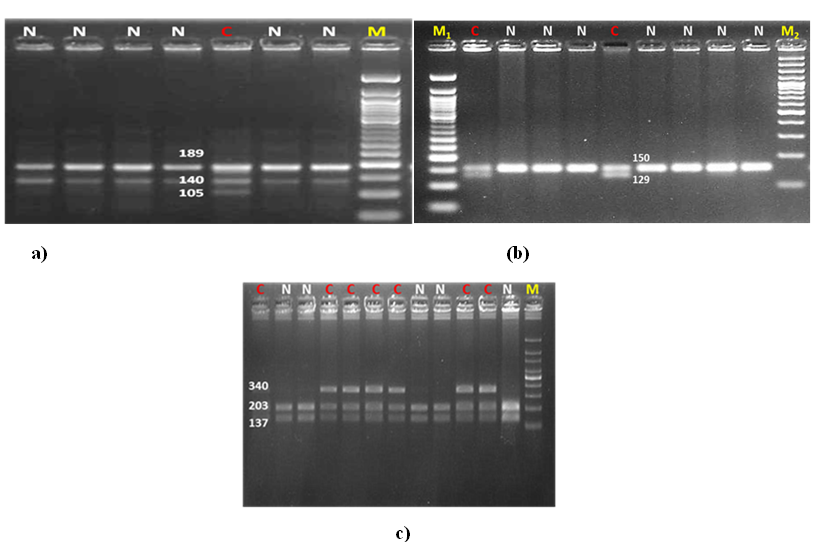
Figure: PCR Assays for detection of HH1, HH3 and JH1 haplotypes in cattle. a) Tetra-ARMS-PCR based assay for HH1 screening. M: 50 bp ladder, C: HH1Carrier (189, 140,105 bp) N: Normal (189, 140bp); b) PCR Primer-introduced restriction analysis based assay for HH3 screening. M1: 50 bp ladder, M2: 100 bp ladder, C: HH3 Carrier (150, 129, 21 bp) N: Normal (150 bp); and c) PCR-RFLP assay for JH1. Lane M: 100 bp ladder, C: JH1 Carrier and N: Normal. Outer primer set (OF and OR) of T-ARMS PCR was used to produce the PCR product (340 bp).
system